
How College Can Close the Gaps
It All Begins Here
We hear a lot about the digital divide, that glowing little canyon between those with Wi-Fi and those without. But beneath it, older and deeper, runs the educational divide: the great quiet sorting machine that decides who gets a ladder and who gets a locked door.
College was supposed to be the ladder.
For some, it still is. For others, it has become a palace with a paywall, a maze with Latin signs, a future sold in installments with interest. We tell young people to dream, then hand them a bill large enough to make the dream sweat. We say education is freedom, then design systems that make freedom feel like a private club.
But the future of education does not have to look like this.
It can be stranger, brighter, and more human.
To close the gaps, colleges have to stop acting like knowledge is a rare mineral buried under ivy. Knowledge is a public fire. It should be carried, shared, and used to light other fires. That means making college less about gatekeeping and more about guiding.
Students need real pathways, not just glossy brochures. They need advisors who know their names, schedules that respect working lives, childcare that does not treat parenting like a personal flaw, and technology that opens doors instead of measuring who can afford the newest key.
The future of education should be flexible without being flimsy. Online classes, hybrid programs, certificates, apprenticeships, community college pipelines, and hands-on learning can all belong in the same universe. A student should not have to choose between feeding their family and feeding their mind.
And let us be honest: leveling the playing field means admitting the field was never level. Some students arrive with tutors, savings accounts, and parents who speak fluent FAFSA. Others arrive with grit, bus passes, night shifts, and the kind of courage no admissions essay can fully hold.
Colleges must build for those students, not as charity, but as justice. Not as a special program hidden in the basement, but as the blueprint.
This means teaching future skills: AI literacy, media literacy, climate literacy, financial literacy, and the ancient human arts of questioning power and telling the truth. It means preparing students not just to “compete in the workforce,” but to remake the workforce into something less cold, less cruel, and less allergic to humanity.
The classroom of the future should not be a factory line. It should be a greenhouse.
Some students need sunlight. Some need water. Some need the soil changed because the old soil was poisoned long before they got there. The point is not to make every flower identical. The point is to make growth possible.
College can close the gaps by remembering what education is for. Not prestige. Not rankings. Not turning young people into well-dressed machines.
Education is for liberation. It is for giving people the tools to read the room, read the world, and then rewrite both.
The future is coming fast, all neon and algorithms, all climate alarms and robot whispers. We can either let it widen the divide, or we can build bridges sturdy enough for everyone to cross.
And maybe that is the work now: not simply preparing students for the future, but preparing a future worthy of students.
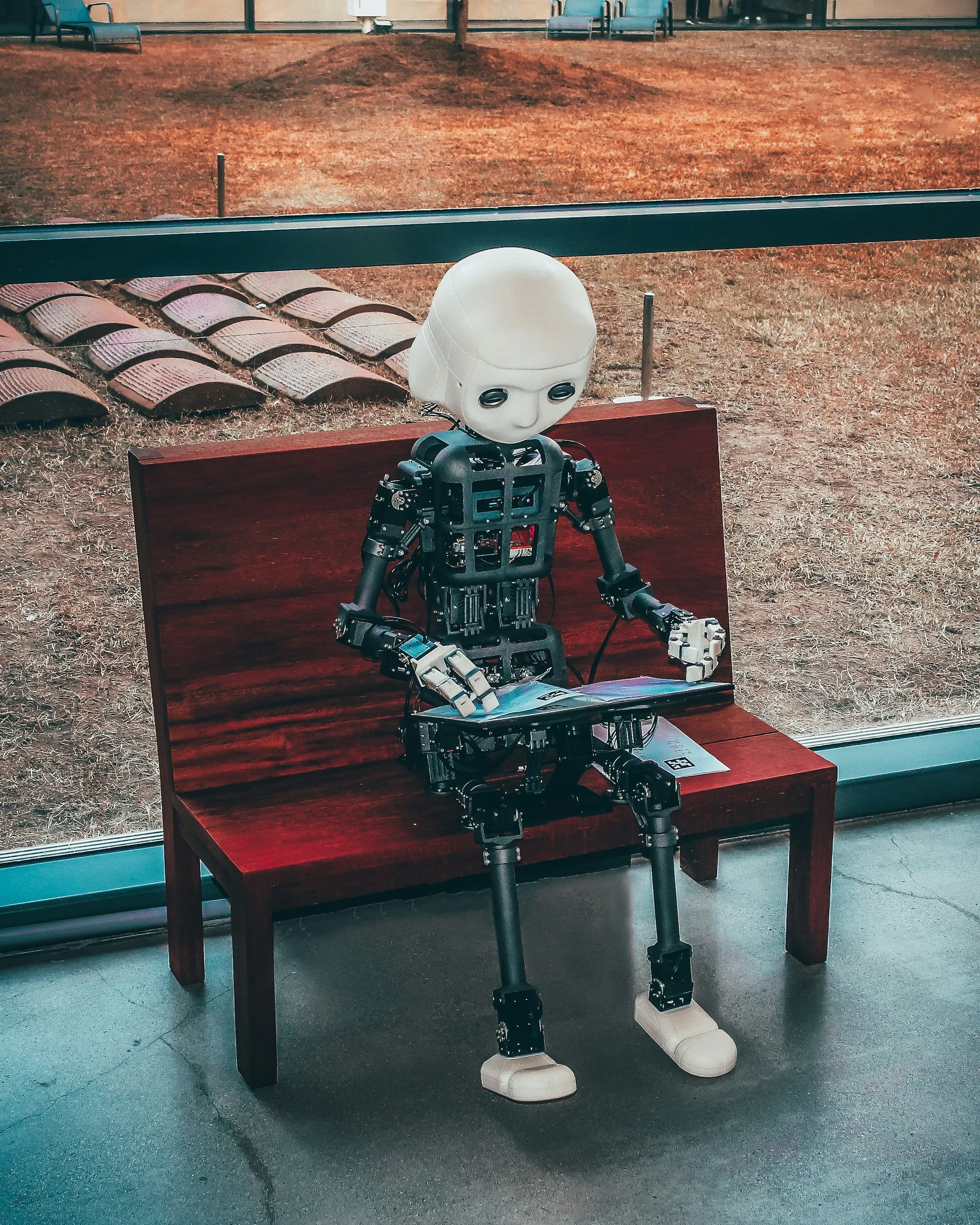
What Students are Saying about AI and Coursework
It All Begins Here
Disruptive technology. That is one of those phrases people love to drop into classrooms, meetings, and articles with very serious fonts. It sounds shiny and dangerous, like a robot knocking over a bookshelf.
But what does it really mean? Well…
School before the internet was different. School during the internet was different. And now school with AI is different all over again. Every generation gets its strange machine. The calculator. The search engine. The smartphone. The blinking portal in your pocket that can tell you the weather in Paris, solve an equation, ruin your attention span, and show you a raccoon washing cotton candy in under ten seconds.
Now students have AI.
And everyone is acting shocked. But students are not shocked. Students are tired. They are juggling homework, jobs, internships, family responsibilities, rising tuition, rent that behaves like a villain, and a future that keeps moving the finish line. So when a tool appears that can explain, outline, brainstorm, organize, summarize, and rescue them from a blank page at 1:17 in the morning, of course they are going to use it.
The question is not, “Why are students using AI?” The question is, “Why did we build an education system so overloaded that a machine feels like mercy?”
That does not mean students should hand over their brains to the glowing box. Knowledge still matters. Thinking still matters. Your voice still matters. AI can write a paragraph, but it cannot live your life. It cannot carry your grandmother’s advice, your neighborhood, your weird little sense of humor, your anger, your questions, your history, your hunger.
AI can be a tool, but it should not become the author of your mind.
Students are saying that AI helps them get started. It helps them understand confusing material. It makes coursework feel less like drowning in a locked room. But they are also saying, sometimes without saying it directly, that school has not always taught them how to learn in this new world.
That is where colleges have work to do. Do not just ban the tool and call it integrity. Teach the tool! Teach students how to use AI ethically, critically, and creatively. Teach them when it helps and when it harms. Teach them how to fact-check it, question it, challenge it, and refuse it. Teach them that using AI to understand a concept is not the same as using it to avoid understanding altogether.
Because the future will not ask, “Did you memorize the old rules?”
The future will ask, “Can you think when the rules change?”
And the rules are changing. Fast.
AI is not the end of education. It is a mirror held up to education. It shows us the cracks: the burnout, the inequity, the busywork, the fear, the outdated assignments dressed up like tradition. It also shows us possibility. More access. More support. More ways for students to learn at their own pace and in their own language.
The danger is not that students will use AI. The danger is that we will pretend they are not.
So let us be honest. Let us be curious. Let us stop treating students like criminals for reaching toward the tools of their own century.
The classroom does not need to become a police state with Wi-Fi. It needs to become a place where students learn how to be human in a world full of machines.
Because AI can generate answers.
But education can generate people who know which answers are worth trusting.

Turn Intention Into Action
It All Begins Here
Confidence doesn’t always arrive with a bold entrance. Sometimes, it builds quietly, step by step, as we show up for ourselves day after day. It grows when we choose to try, even when we’re unsure of the outcome. Every time you take action despite self-doubt, you reinforce the belief that you’re capable. Confidence isn’t about having all the answers — it’s about trusting that you can figure it out along the way.
The key to making things happen isn’t waiting for the perfect moment; it’s starting with what you have, where you are. Big goals can feel overwhelming when viewed all at once, but momentum builds through small, consistent action. Whether you’re working toward a personal milestone or a professional dream, progress comes from showing up — not perfectly, but persistently. Action creates clarity, and over time, those steps forward add up to something real.
You don’t need to be fearless to reach your goals, you just need to be willing. Willing to try, willing to learn, and willing to believe that you’re capable of more than you know. The road may not always be smooth, but growth rarely is. What matters most is that you keep going, keep learning, and keep believing in the version of yourself you’re becoming.

Make Room for Growth
It All Begins Here
Confidence doesn’t always arrive with a bold entrance. Sometimes, it builds quietly, step by step, as we show up for ourselves day after day. It grows when we choose to try, even when we’re unsure of the outcome. Every time you take action despite self-doubt, you reinforce the belief that you’re capable. Confidence isn’t about having all the answers — it’s about trusting that you can figure it out along the way.
The key to making things happen isn’t waiting for the perfect moment; it’s starting with what you have, where you are. Big goals can feel overwhelming when viewed all at once, but momentum builds through small, consistent action. Whether you’re working toward a personal milestone or a professional dream, progress comes from showing up — not perfectly, but persistently. Action creates clarity, and over time, those steps forward add up to something real.
You don’t need to be fearless to reach your goals, you just need to be willing. Willing to try, willing to learn, and willing to believe that you’re capable of more than you know. The road may not always be smooth, but growth rarely is. What matters most is that you keep going, keep learning, and keep believing in the version of yourself you’re becoming.